- Creative Discipline
- Posts
- 145: How a $4,500 Video Changed DTC Marketing Forever (Dollar Shave Club - ( Part 1)
145: How a $4,500 Video Changed DTC Marketing Forever (Dollar Shave Club - ( Part 1)
A Creative History on Dollar Shave Club - Part One

Chase Mohseni
April 02, 2026

The improv comedian, the warehouse full of razors, and the three-minute ad that broke the interne
Hey everyone, Chase here from CreativeOS.
On March 6, 2012, a 33-year-old former advertising copywriter named Michael Dubin uploaded a video to YouTube.
Budget: $4,500. Location: A warehouse in Venice, California. Runtime: 1 minute and 33 seconds.
Twelve hours later, his website crashed.
In two days, Dollar Shave Club had received 12,000 orders.
By the end of the week, the video had been viewed over 4 million times.
Dubin had spent almost nothing. He had no media budget. He had no distribution deal. He had a camera, a warehouse, a case of razors, and a script he wrote himself.
This is Part 1 of Dollar Shave Club - from a conversation at a party to the ad that invented DTC marketing.
In this issue, you'll learn:
How Dubin's improv background became the brand's biggest competitive advantage
Why the ad worked when no one expected it to
What the video actually says about creative discipline — and why its lessons don't go where you think
The party where it started.
In 2010, Michael Dubin met a man named Mark Levine at a holiday party in Los Angeles.
Levine's family owned a warehouse full of Korean-manufactured razor cartridges that weren't moving. He'd been trying to figure out what to do with them for months.
Dubin had been working in digital media and advertising. He'd also spent years doing improv comedy at Upright Citizens Brigade - a training ground known for producing writers for SNL, The Daily Show, and The Office.
The idea came together in a conversation that probably lasted twenty minutes.
Dubin would build a subscription razor company. Levine would supply the product. The pitch was simple: men were overpaying for razors. Gillette had spent decades using patent protection and retail dominance to keep prices artificially high. A direct-to-consumer model could undercut them significantly and go straight to the customer.
It wasn't a new observation. But Dubin had something most entrepreneurs don't.
He knew how to be funny on camera.

Building the video.
Dollar Shave Club launched officially in January 2012. For the first two months, Dubin focused on building inventory and the subscription infrastructure.
Then he made the video.
The script took him two weeks to write. He rehearsed it obsessively — his improv background meant he understood the difference between a line that looks good on paper and a line that actually lands when delivered.
The production was chaotic. They shot in a working warehouse. The bear costume they'd rented didn't fit. A baby woke up and started crying mid-take. The forklift scene was improvised on set.
Dubin kept most of it in.
The line that made the video: "Our blades are f**ing great."*
It wasn't an accident. It was a deliberate decision to say the thing that brand voice guidelines would normally kill. The kind of line a person says to a friend, not the kind of line a company says in an ad.
And that distinction is the entire creative lesson.

Why the ad worked.
By 2012, YouTube pre-roll ads had trained an entire generation to hit "skip" after five seconds. Branded content was polished, produced, and trusted approximately as much as a cold call.
The Dollar Shave Club video violated every implicit rule.
It was clearly low-budget. The warehouse was unglamorous. The jokes were loose and slightly unhinged. Dubin walked through a wall of hanging envelopes and nobody cleaned it up before the shot.
But it was genuinely funny. Not marketing-funny, where the brand winks at you and you groan. Actually funny. The kind of funny that makes you send something to a friend.
Here's the mechanism everyone misses: the video spread not because it was entertaining, but because sharing it said something about the person sharing it.
Forwarding a funny video in 2012 was a social signal. It meant: I have good taste. I find this stuff before other people do. The video made the sharer look smart for discovering it.
This is what separates content that gets watched from content that gets shared. Watched content is good enough to finish. Shared content carries social currency — something the person forwarding it gets to claim.
Dubin didn't design the video to go viral. He designed it to explain a subscription model to people who didn't understand why they needed it. The viral spread was a byproduct of making something genuinely worth sharing.
"Do you think your razor needs a vibrating handle, a flashlight, a back-scratcher, and ten blades? Your handsome-ass grandfather had one blade and polio. He did just fine."
That's not marketing. That's a point of view. And a point of view is always more shareable than a product claim.
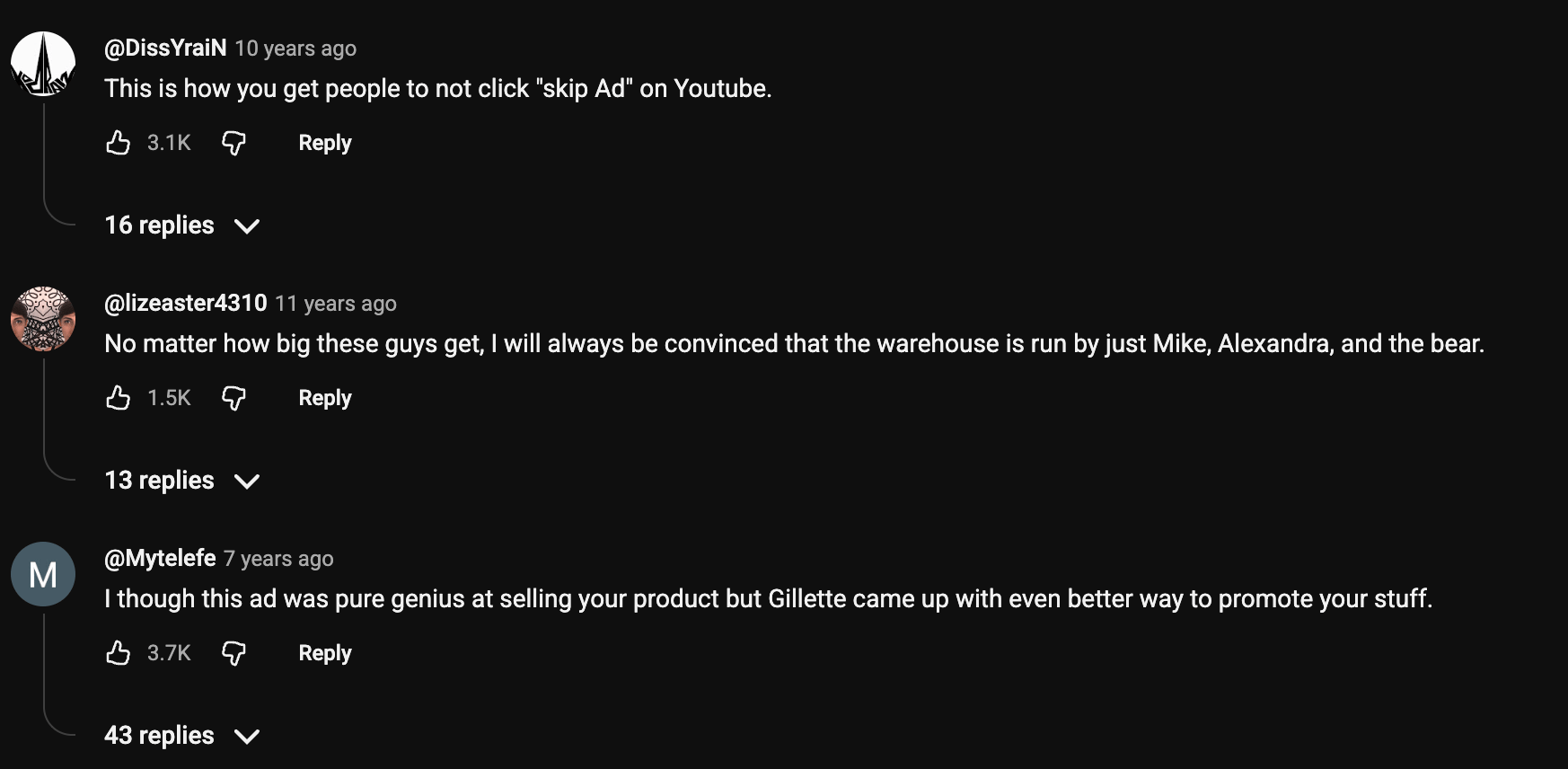
These are comments from the original YouTube video from 2012
Every week I break down what makes ads & creative work.
CreativeOS is where you go to actually build them.
20,000+ templates. AI that learns your taste. A creative engine that gets smarter every time you use it. Don’t start from scratch - your taste can now scale.
It's the platform behind the newsletter.
Try CreativeOS free → — use code CREATIVEDISCIPLINE for 25% off your first month.
Why Gillette couldn't copy it.
Here's the part that gets overlooked in every Dollar Shave Club case study.
Gillette had more money, more distribution, more brand recognition, and more engineering talent. They had every resource that should have made competing easy.
What they couldn't do was be funny.
Gillette's brand had been built for thirty years on masculine authority. "The best a man can get." Professional athletes. Serious product claims. The entire identity was built on the premise that Gillette was a serious brand for serious men.
You can't pivot from "The best a man can get" to "Our blades are f***ing great" without destroying the authority you spent decades building. The voice would be incoherent. Customers wouldn't trust it.
This is why brand voice is a competitive moat that money can't solve. The DSC video worked because Dubin had no legacy positioning to protect. He could say anything. Gillette had to protect what they'd already said.
When your competitor's biggest strength — decades of brand equity — becomes the thing that prevents them from responding to you, you've found a structural advantage. Dubin didn't outspend Gillette. He built something Gillette couldn't copy without contradicting itself.
What the video didn't tell you.
Here's the part of the Dollar Shave Club story that gets left out.
The video got the orders. But orders aren't a business.
In the first 48 hours after the video went live, Dubin received 12,000 orders for a product his warehouse could barely fulfill. The site crashed. Customer service didn't exist yet. Shipping was chaos.
He stayed up for days processing orders manually. He hired anyone he could find. He called in favors. He printed labels by hand.
The creative was perfect. The operational reality was a full-scale emergency.
Dollar Shave Club survived that emergency. But the real story of how it went from a viral video to a $1 billion acquisition was never about the ad.
It was about what Dubin built while everyone was talking about the ad.
Next week: how Dollar Shave Club turned a one-time video hit into a subscription machine — and what Unilever paid $1 billion to buy.
Keep Creating,
Chase
P.S. — Sign up for our events calendar so you can get access to all the experts we work with helping you build your creative intelligence in real time.